
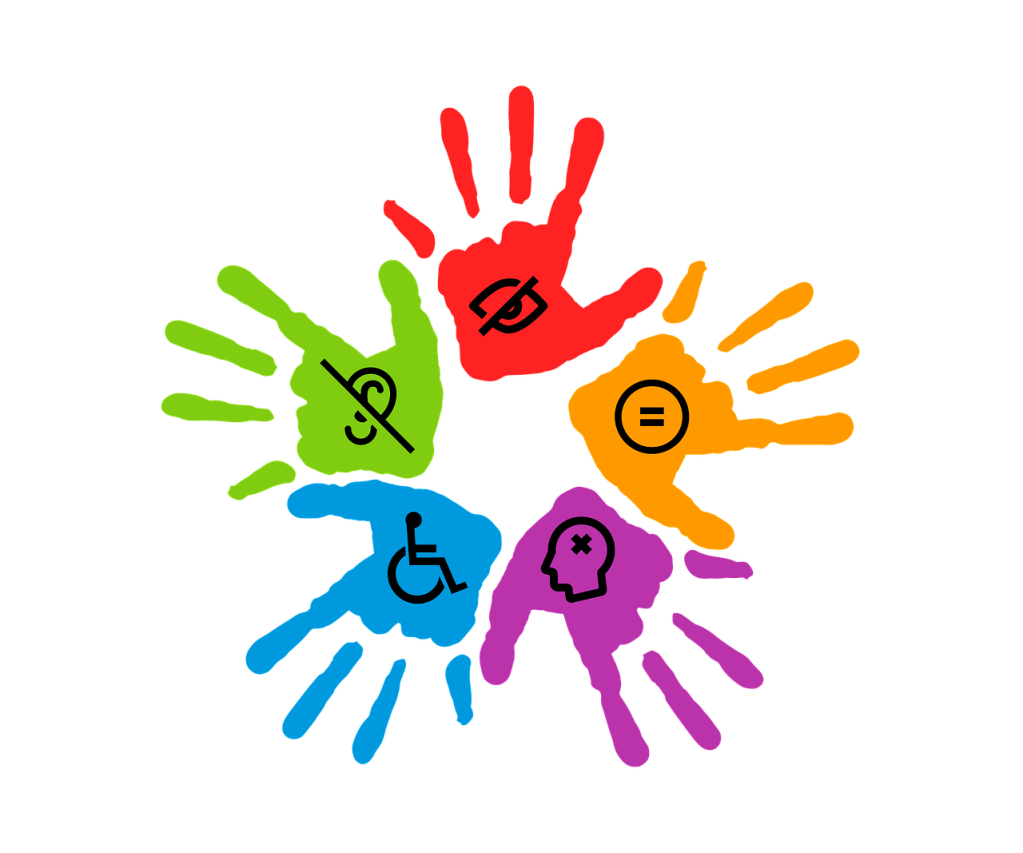
“Inclusion” by Rosy on Pixabay.com
My colleague and I have two chapters in an upcoming book about home visiting. In these chapters, we explore and develop a new model for home visitors to re-think how they approach therapy/intervention/instruction with families from culturally and linguistically diverse (CLD) backgrounds.
One of the topics we cover is inclusion from the perspective of a mainstream culture clinician working with families from CLD backgrounds. That’s an increasingly important factor we need to consider when we work with anyone who comes from a different background than we do.
But, this last week, I’ve been thinking more and more about the need to expand the meaning of inclusion as it relates to people with complex communication needs (CCN). I’ve been thinking more and more about the majority of clients I support. I primarily work with clients who are preschool- and school-age. Most of the kids have some kind of medical diagnosis – be that cerebral palsy or prenatal drug exposure or autism spectrum disorder or rare disorders like DiGeorge’s syndrome. Many of the kids I support have multiple diagnoses. Many are limited verbal or non-verbal communicators. Many of my clients use AAC or AT to communicate or to expand their circle of communication partners.
Inclusion Means Being Included in Your Own Life
Let’s start with something that happens every day to people who can’t communicate as effectively with oral language as you or I. Imagine this:
You’re an almost 8 year-old child who is non-verbal. You have a rare genetic disorder that causes cardiac, respiratory, and physical changes from what’s “normal” for starters. It’s left you immunocompromised. You’ve got a tracheostomy which has been placed since you were an infant. You also have a G-tube which has been placed since you were a baby. You’ve had multiple surgeries, including heart surgery and brain surgery. Your body is covered in scars from the surgeries, from the central lines, and IVs. You’ll have more surgeries as you grow, major surgeries that most people don’t face until they’ve had a chance to live their lives. You live at home with your parents, your older sister, and your dog. You have a full-time nurse to help your parents with the complexities of your medical care. You stay at home most of the time because when you get sick it quickly becomes life-threatening. Your world consists of your family, the nurse, your house, the therapists who come see you several times a week, and the medical staff who come see you at home, too. Now, a teacher is coming to see you, but you’ve never been to school. When you go out, it’s most often to medical appointments. Although, you do like going on car rides with the nurse and your dog – as often as possible, please!
You breathe through a hole in your neck. You get your nutrition and hydration through a hole in your stomach. It is what it is. You don’t remember anything else. But, what you don’t know and what the adults in your life don’t realize is the trach and the G-tube mean food really has no interest for you. You never really get hungry because there’s a schedule for your “feeds” – that tan stuff that just goes through the tube into your belly. Because you breathe through the trach, you don’t smell or taste flavors the same as someone who is able to breathe through their nose and mouth. “Food” is unfamiliar textures of stuff that gets forced into your mouth by other people. None of it has much taste. Because your mouth is always dry, chewing is next to impossible. Plus, what’s the point? You’re not hungry anyway. You don’t need to close your mouth to breathe through your nose. What’s the point? The air comes and goes through the hole in your neck and is sometimes forced in and out by the ventilator. To you, the ventilator just means another set of tubes and hoses that make you stay on your bed for that much longer every day.
But, you’re a busy almost 8-year old boy with things to do. You can walk independently even if uneven surfaces can be a bit challenging. You can use both of your hands – to find things to do when you get bored. You get bored often because there isn’t much to do during the day. You’re interested in the way things work – like what makes one of your favorite toys move the way it does. You are eager to learn and you know quite a bit about the larger world even though few people in *your* world are aware of what you know already.
You communicate with the people in your world through body language and body posturing, facial expressions, vocalizations (even with the trach you can be quite loud when you want to be!), natural gestures, and sign approximations (you have some difficulty using your fingers like everyone else, but you do the best you can). For the most part, however, you communicate with people using a speech-generating device – your “tablet.” Some people know how to use it and use it with you better than others. It’s getting older and it’s glitchy sometimes. And, you’re a kid, so if you can get away with just one word, you’re going to. It can be hard to use it, though. Someone else has to program your tablet. So, not all the words you want to say are there when you need them. And, because someone else has to program your tablet, they can take words away, too. That never happens to your sister because she can talk (a lot! And, she talks for you all the time!)
Some people don’t use your tablet with you at all or sometimes the tablet just doesn’t work. Sometimes, adults take it away from you or leave it behind. Then, you’re left having to figure out how to communicate with them. You’re shorter than everyone else in your world. Few adults bother to get down on your level where you can use your eyes and facial expressions to communicate with them – even with the tablet. You understand a lot of what people say to you. But, you need a minute to make your body do what you want it to. Some people get that and give you time (or [gasp] expect you to do things on your own!). But, if your sister’s around and someone asks you to do something you need a second to do on your own, she’ll grab you under the arms and drag you out of the chair, off the floor, whatever. Most of the time, it doesn’t bother you. But, it’s starting to bug you more and more as you learn you can do things on your own.
The worst thing is people seem to think that because you can’t say words that you’re not listening or that you can’t understand what they’re saying. They talk about you like you aren’t even in the room. They give a play-by-play of everything you’re doing like they’re watching it on TV (“Oh look, he’s playing with his new toy!”). Or, they give their run-down of how the day or the session have gone, (“He’s not listening very well today. He threw the crayons after I told him no. He ripped up the paper. He’s being bad.”) Sometimes, they’ll even tell other people how you feel (“He’s happy today!”) – not that anyone asked you!
Even when the rare person asks you what you want or like or how you’re doing, other people in the room answer for you right away (“Oh, he doesn’t like that!”). You don’t get a chance to say what you want or like for yourself, even though you can if they give you a chance. Even when you show them you’re listening, they just don’t seem to get that you understand. Sometimes, you start doing what they’re talking about just to show them you’re listening. All they do is talk about it like you’re not there. You do things you know you’re ‘supposed’ to do, just to get their attention. And, you think it’s funny. Because a lot of them haven’t figured out you have a really great sense of humor. Just like most of them haven’t bothered to figure out that you actually know a lot about the world around you.
Your life has always been like this. But, you’re not a little kid anymore. And, it’s starting to bug you. You have your own thoughts and opinions and you’re starting to find ways to express them. Other people say you’re being bad or being naughty. But, you see it differently. You just want to be included in your own life.
If You Were This Child, How Would You Feel?
These are some the real-life experiences of a client I support. I’ve seen all of these things happen to him. Things are done to and for him; he has limited opportunity to really tell people what he wants, or likes, or thinks. I think about how I’d feel if I were him. I think I’d feel like I was on the outside looking through the window of my own life. And, I think I’d find ways to fight against it, too.
I think I’ll stop this post here. I’ll continue the next post with some of the things I observed about this kiddo and some of the things I’m doing to make sure he’s included in his own life.
 Outside The Box